
Market findings
The September 2026 MBB snapshot contains 192 indexable 3d printer records. Of those, 179 carry asking prices inside the published $500-to-$5-million analytical range.
The range describes published asking prices in this category—not completed sales and not the value of a particular machine.
Manufacturer mix and asking prices
Representation affects the category result. A heavily listed manufacturer or model family can pull the combined median toward its particular product and age mix.
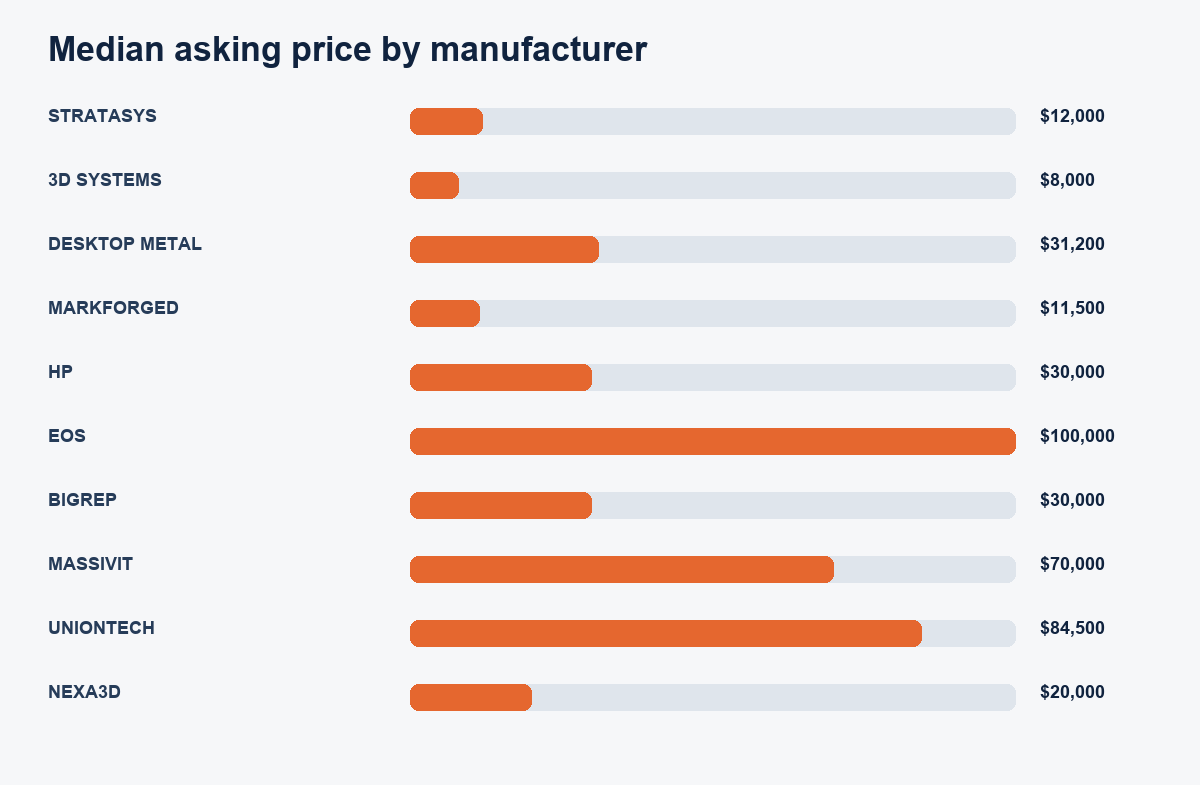
| Manufacturer | Listings | Qualified | Q1 | Median | Q3 |
|---|---|---|---|---|---|
| Stratasys | 82 | 73 | $4,000 | $12,000 | $27,500 |
| 3D Systems | 31 | 31 | $3,500 | $8,000 | $15,000 |
| Desktop Metal | 20 | 20 | $6,250 | $31,200 | $95,750 |
| Markforged | 12 | 12 | $6,075 | $11,500 | $21,250 |
| Hp | 7 | 5 | $10,500 | $30,000 | $35,000 |
| Eos | 5 | 5 | $50,000 | $100,000 | $200,000 |
| Bigrep | 4 | 4 | $24,000 | $30,000 | $35,312 |
| Massivit | 4 | 3 | $57,500 | $70,000 | $100,000 |
| Uniontech | 4 | 4 | $69,500 | $84,500 | $99,500 |
| Nexa3D | 3 | 3 | $17,500 | $20,000 | $26,500 |
Model concentration
Model-level evidence is more useful than a category-wide average, but identical names can still hide option, control, age and condition differences. These counts show the most repeated normalized model labels in the MBB category snapshot.
| Manufacturer and model | Listings | Qualified | Q1 | Median | Q3 |
|---|---|---|---|---|---|
| Stratasys F370 | 14 | 14 | $8,125 | $12,000 | $16,875 |
| 3D Systems Projet 3500Hd | 10 | 10 | $2,750 | $5,750 | $7,750 |
| Stratasys Fortus 400Mc | 10 | 9 | $10,000 | $15,000 | $30,000 |
| Stratasys F170 | 8 | 5 | $2,000 | $2,999 | $5,000 |
| Stratasys J750 | 8 | 6 | $35,100 | $45,400 | $48,950 |
| Desktop Metal Shop System | 7 | 7 | $92,250 | $99,500 | $117,500 |
| Stratasys Fortus 250Mc | 7 | 7 | $4,500 | $8,500 | $11,000 |
| 3D Systems Projet 6000 Hd | 6 | 6 | $11,250 | $15,000 | $24,000 |
| Desktop Metal Studio System | 5 | 5 | $6,500 | $9,999 | $22,000 |
| Hp Mjf 580 | 5 | 4 | $10,375 | $22,750 | $37,500 |
| Markforged Mark Two | 5 | 5 | $6,000 | $6,100 | $7,000 |
| Markforged X7 | 5 | 5 | $20,000 | $25,000 | $28,000 |
Model labels are normalized catalog fields. Confirm the serial number, exact configuration and manufacturer specification before using a model comparison.
Machine age and asking-price spread
Age organizes the search, but it does not replace configuration and condition evidence. The table separates inventory and price ranges by broad production-year band.
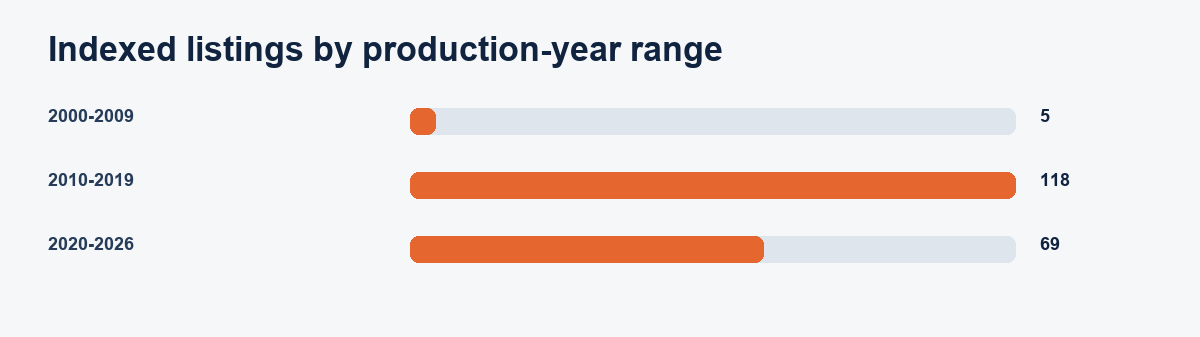
| Production-year band | Listings | Qualified | Q1 | Median | Q3 |
|---|---|---|---|---|---|
| Before 2000 | 0 | 0 | $0 | $0 | $0 |
| 2000-2009 | 5 | 5 | $6,500 | $10,000 | $10,000 |
| 2010-2019 | 118 | 112 | $5,000 | $14,000 | $45,000 |
| 2020-2026 | 69 | 62 | $8,125 | $20,000 | $43,750 |
| Year Not Usable | 0 | 0 | $0 | $0 | $0 |
What this equipment does
Additive manufacturing builds parts from digital designs by adding material layer by layer. NIST describes a family of processes—not one interchangeable machine class—including powder bed fusion, directed energy deposition, material extrusion, vat photopolymerization, binder jetting and material jetting.
A category-wide additive median mixes different materials, processes, build volumes and production purposes. Polymer material extrusion, photopolymer, powder-bed and metal systems can have radically different facility, software, safety and post-processing requirements.
That operating context is essential: an asking-price comparison is strongest when the candidate machines can perform the same work with comparable process capability, capacity and support.
What changes value
No single depreciation curve captures the working differences within this category. Document these factors before comparing the candidate to the published range:
- Additive process, qualified materials, build volume, resolution, throughput and intended applications
- Open or restricted material ecosystem, consumable pricing and remaining manufacturer support
- Software licenses, build preparation, parameter access, service contracts and data portability
- Print heads, lasers, optics, recoaters, motion systems, sensors and calibration status
- Included wash, cure, depowdering, sieving, furnace, extraction and post-processing equipment
- Installation history, usage, preventive maintenance, operating demonstration and facility requirements
Buyer inspection questions
- Identify the exact additive process, materials, serial number, software and support status.
- Verify machine utilization, service history, calibration and the condition of process-critical components.
- Run an appropriate build or review current build-quality evidence, not only a powered control screen.
- Confirm which software licenses, parameter sets, accessories and post-processing systems transfer.
- Review material age, storage, contamination controls and safe handling requirements for the process.
- Price the complete workflow: preparation, printing, cleaning, curing or heat treatment, inspection and waste handling.
Scope boundary: this is an educational framework, not a substitute for an OEM, technician, rigger, electrician, environmental professional, safety professional, attorney or other qualified adviser appropriate to the transaction.
Seller evidence package
Describe the process and workflow, not merely the printer. Identify materials run, build volume, installed software, transferable licenses, service status, utilization, calibration and all wash, cure, powder, furnace or extraction equipment included. A current sample build and maintenance record are stronger evidence than a generic specification sheet.
Define inspection access, deposits, payment timing, loading, removal deadline, risk transfer and the parties responsible for each cost in the written agreement. Buyers and sellers should obtain appropriate professional advice for their facts.
Production readiness and safety
Additive site planning varies by process. Review electrical and ventilation needs, temperature and humidity control, inert gas or compressed air, material storage, powder or resin handling, fire and exposure controls, post-processing, inspection, waste and software infrastructure with qualified professionals.
Material and process hazards vary. NIST provides process definitions and standards context; site-specific ventilation, fire protection, chemical or powder handling, personal protective equipment and hazardous-energy controls require qualified review and the applicable manufacturer and regulatory guidance.
Methods, limits and download
MBB filtered the September 25, 2026 catalog snapshot to indexable records whose normalized category equals “3D Printer.” Price statistics include numeric asking prices from $500 through $5 million. The median is the 50th percentile; Q1 and Q3 mark the middle half of retained prices.
The records are not a probability sample of all machines. Source mix, omitted prices, stale listings, duplicate commercial exposure and incomplete machine facts can bias the result. Public aggregate downloads omit personal information, private records and row-level third-party listing data.
Cite this report
Machine Blue Book. “2026 Industrial 3D Printer Market Report.” September 29, 2026. https://themachinebluebook.com/reports/2026-industrial-3d-printer-market/
Charts and short excerpts may be quoted with clear attribution and a link to this report. Contact info@themachinebluebook.com for aggregate research questions.