
Market findings
The September 2026 MBB snapshot contains 4,021 indexable cnc lathe records. Of those, 3,410 carry asking prices inside the published $500-to-$5-million analytical range.
The range describes published asking prices in this category—not completed sales and not the value of a particular machine.
Manufacturer mix and asking prices
Representation affects the category result. A heavily listed manufacturer or model family can pull the combined median toward its particular product and age mix.
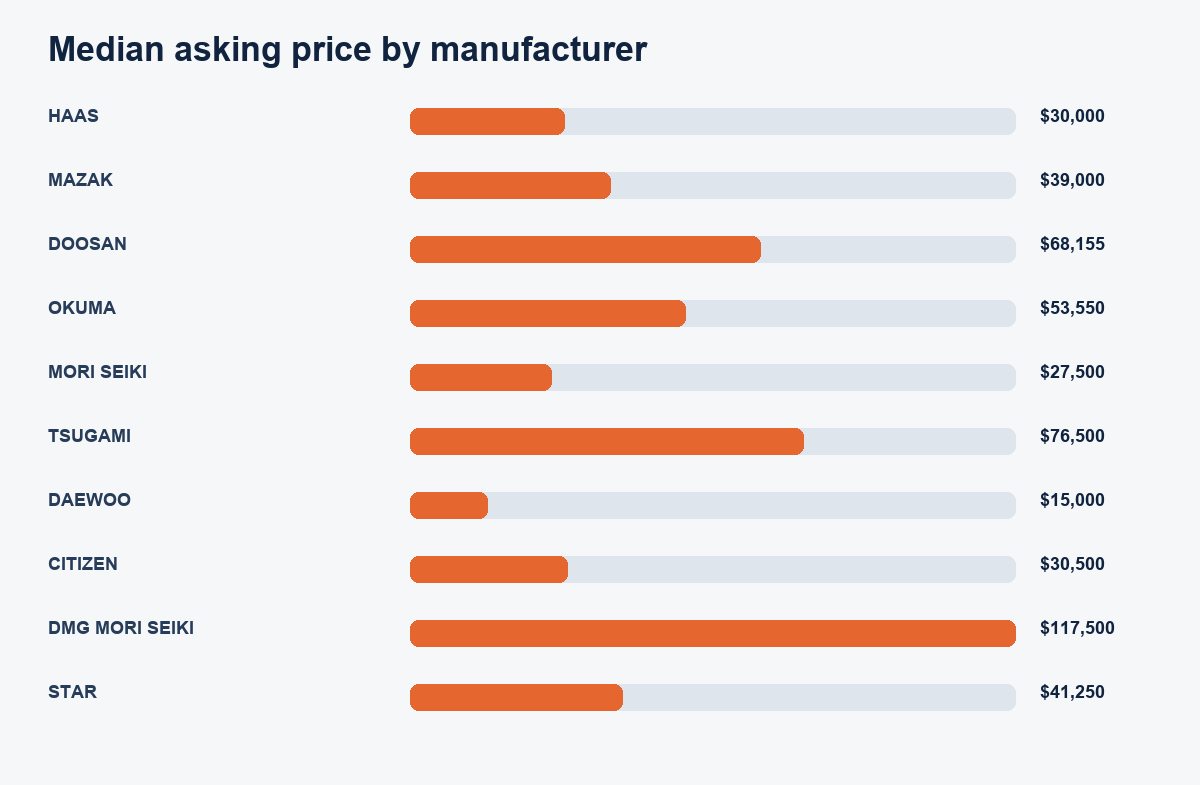
| Manufacturer | Listings | Qualified | Q1 | Median | Q3 |
|---|---|---|---|---|---|
| Haas | 1,147 | 980 | $18,500 | $30,000 | $53,000 |
| Mazak | 614 | 537 | $15,000 | $39,000 | $85,000 |
| Doosan | 385 | 324 | $34,879 | $68,155 | $120,000 |
| Okuma | 279 | 243 | $17,775 | $53,550 | $120,000 |
| Mori Seiki | 160 | 135 | $12,500 | $27,500 | $46,000 |
| Tsugami | 149 | 130 | $35,550 | $76,500 | $133,750 |
| Daewoo | 118 | 108 | $10,000 | $15,000 | $25,000 |
| Citizen | 90 | 68 | $19,500 | $30,500 | $70,000 |
| Dmg Mori Seiki | 84 | 62 | $72,125 | $117,500 | $187,500 |
| Star | 63 | 52 | $14,250 | $41,250 | $100,000 |
Model concentration
Model-level evidence is more useful than a category-wide average, but identical names can still hide option, control, age and condition differences. These counts show the most repeated normalized model labels in the MBB category snapshot.
| Manufacturer and model | Listings | Qualified | Q1 | Median | Q3 |
|---|---|---|---|---|---|
| Haas St30 | 74 | 65 | $29,500 | $38,250 | $49,000 |
| Haas Sl30T | 72 | 66 | $15,000 | $17,932 | $22,875 |
| Haas St10 | 71 | 63 | $27,700 | $32,000 | $40,000 |
| Haas Sl20T | 70 | 60 | $12,938 | $18,000 | $22,500 |
| Haas St20 | 57 | 48 | $29,000 | $37,700 | $50,375 |
| Haas St20Y | 54 | 45 | $64,125 | $75,000 | $90,000 |
| Haas Tl2 | 54 | 48 | $15,900 | $22,575 | $31,500 |
| Haas Tl1 | 48 | 44 | $14,750 | $20,750 | $27,900 |
| Haas Sl10 | 47 | 39 | $13,000 | $17,000 | $20,500 |
| Haas Sl20 | 43 | 37 | $13,000 | $16,500 | $24,000 |
| Haas St25 | 27 | 23 | $36,900 | $44,300 | $56,500 |
| Haas Cl1 | 26 | 19 | $25,500 | $32,500 | $37,050 |
Model labels are normalized catalog fields. Confirm the serial number, exact configuration and manufacturer specification before using a model comparison.
Machine age and asking-price spread
Age organizes the search, but it does not replace configuration and condition evidence. The table separates inventory and price ranges by broad production-year band.
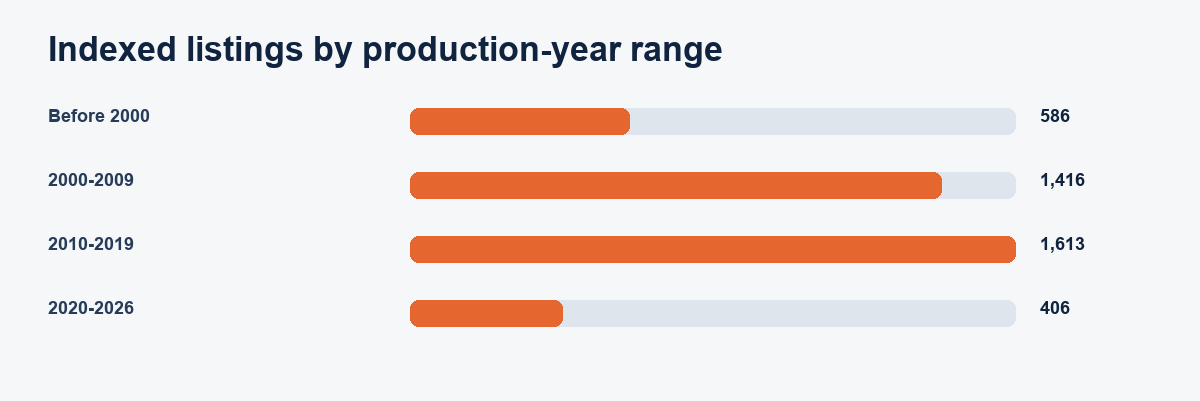
| Production-year band | Listings | Qualified | Q1 | Median | Q3 |
|---|---|---|---|---|---|
| Before 2000 | 586 | 490 | $6,000 | $10,000 | $17,000 |
| 2000-2009 | 1,416 | 1,236 | $15,000 | $23,000 | $39,863 |
| 2010-2019 | 1,613 | 1,366 | $35,000 | $62,000 | $110,000 |
| 2020-2026 | 406 | 318 | $54,000 | $100,000 | $160,000 |
| Year Not Usable | 0 | 0 | $0 | $0 | $0 |
What this equipment does
A CNC lathe removes material while the workpiece rotates. Turning centers can add live tooling, C- or Y-axis motion, subspindles, bar feeding, parts handling and milling functions, so two machines grouped under the same broad category may support very different production plans.
The turning category spans toolroom lathes, two-axis production machines, Swiss-type systems, vertical turning centers and multi-axis, twin-spindle platforms. Chuck size or maximum turning diameter alone cannot explain value.
That operating context is essential: an asking-price comparison is strongest when the candidate machines can perform the same work with comparable process capability, capacity and support.
What changes value
No single depreciation curve captures the working differences within this category. Document these factors before comparing the candidate to the published range:
- Turning diameter, turning length, bar capacity, spindle bore and chuck configuration
- Two-axis versus live tooling, C axis, Y axis, subspindle, twin turret or Swiss configuration
- Spindle speed, power, bearing condition and evidence under load
- Turret type, station count, alignment, live-tool holders and included workholding
- Bar feeder, parts catcher, chip conveyor, high-pressure coolant and automation interfaces
- Control generation, hours, maintenance, geometry and service or parts availability
Buyer inspection questions
- Confirm main- and subspindle specifications, chuck or collet hardware, bar capacity and included tooling.
- Run each spindle and live-tool station; document noise, temperature, vibration and alarms.
- Index the turret repeatedly and verify alignment, clamp condition and every driven-tool position.
- Check axes, backlash, tailstock, parts catcher, bar feeder, conveyor, lubrication and coolant systems.
- Review a representative cutting cycle and inspect a part when the transaction warrants it.
- Model the complete cell: machine, feeder, workholding, tooling, metrology, mist control and restart cost.
Scope boundary: this is an educational framework, not a substitute for an OEM, technician, rigger, electrician, environmental professional, safety professional, attorney or other qualified adviser appropriate to the transaction.
Seller evidence package
Document the exact turning configuration. A listing should distinguish a basic two-axis lathe from a live-tool, Y-axis or subspindle platform and identify chuck, collet, feeder, holders, presetter and conveyor inclusions. Current operating evidence and clean payment/removal terms reduce ambiguity.
Define inspection access, deposits, payment timing, loading, removal deadline, risk transfer and the parties responsible for each cost in the written agreement. Buyers and sellers should obtain appropriate professional advice for their facts.
Production readiness and safety
Turning cells need room for the machine, control access, bar feeder or automation, stock loading, chip handling and maintenance. Verify floor, power, transformer needs, air, coolant and mist management, bar length, material flow, tooling standards and service support.
Rotating workholding, stock, chuck jaws and bar-feed systems create machine-specific hazards. Qualified reviewers should address guarding, interlocks, safe workholding, electrical requirements and hazardous-energy control. OSHA's standards page points to general requirements and ANSI B11 standards for lathes and turning machines.
Methods, limits and download
MBB filtered the September 25, 2026 catalog snapshot to indexable records whose normalized category equals “CNC Lathe.” Price statistics include numeric asking prices from $500 through $5 million. The median is the 50th percentile; Q1 and Q3 mark the middle half of retained prices.
The records are not a probability sample of all machines. Source mix, omitted prices, stale listings, duplicate commercial exposure and incomplete machine facts can bias the result. Public aggregate downloads omit personal information, private records and row-level third-party listing data.
Cite this report
Machine Blue Book. “2026 CNC Lathe Market Report.” September 29, 2026. https://themachinebluebook.com/reports/2026-cnc-lathe-market/
Charts and short excerpts may be quoted with clear attribution and a link to this report. Contact info@themachinebluebook.com for aggregate research questions.